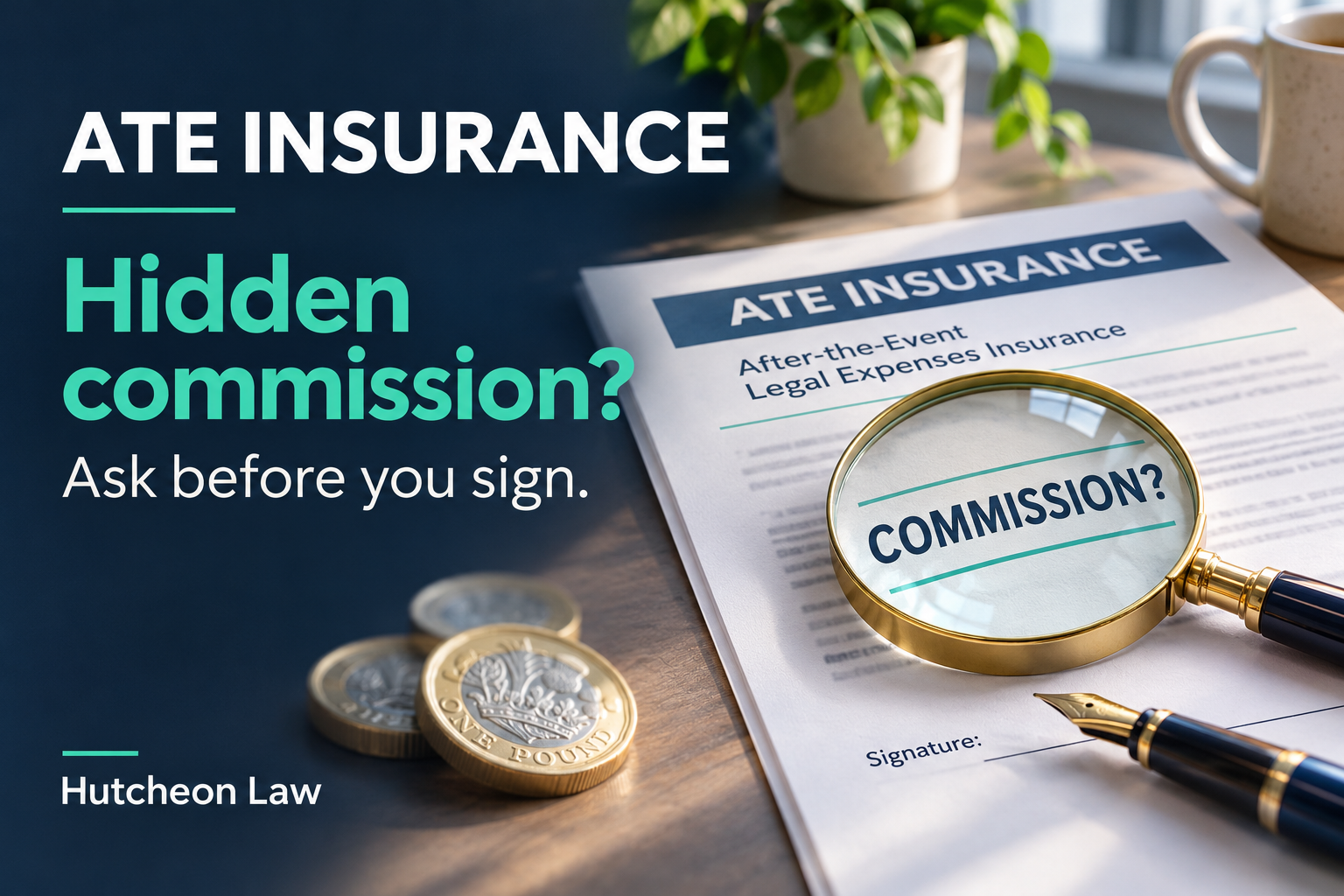
ATE Insurance and Secret Commissions: Ask Before You Sign
You have been injured. You need advice. A solicitor offers to handle your claim on a no win, no fee basis and recommends insurance to protect you against certain legal costs.
Before you sign, there is a question worth asking:
“Will your firm, or any connected business, receive commission or another financial benefit from arranging this insurance?”
Then ask how much, who receives it and whether you are being asked to agree that they can keep it.
These are reasonable questions about your money. You should not feel awkward asking them.
What is ATE insurance?
After the event insurance, usually called ATE insurance, is taken out after the accident or event giving rise to a claim. Depending on the policy, it can protect against certain legal costs and expenses if your case fails.
It often sits alongside a no win, no fee agreement when pursuing a personal injury claim or a medical negligence claim.
Your funding agreement deals with your solicitor’s charges. The insurance covers the particular risks set out in the policy. Both need explaining: a no win, no fee arrangement should never leave you guessing about what you might have to pay.
Ask what is covered, what is excluded and when the premium becomes payable. If it will come out of your compensation, you need to know before agreeing.
What are secret commissions on ATE insurance?
An insurer or intermediary may pay a solicitor commission or provide another financial benefit for arranging insurance.
Receiving commission does not, by itself, establish wrongdoing. The concern is whether the arrangement has been properly disclosed, whether the solicitor is entitled to retain the benefit and whether the recommendation serves the client’s interests.
Paragraph 4.1 of the SRA Code of Conduct for Solicitors requires solicitors to account to clients for financial benefits arising from their instructions unless the clients have agreed otherwise.
The SRA’s insurance distribution rules also require firms within their scope to explain the nature of their remuneration before the insurance contract is concluded. That includes whether they receive commission, a fee or another economic benefit. Remuneration arrangements must not conflict with the client’s best interests.
Do not stop at asking what the policy costs. Ask who benefits from arranging it.
What did Turner v Coupland Cavendish decide?
The issue came before the Court of Appeal in Turner v Coupland Cavendish Ltd [2026] EWCA Civ 1204.
A former client wanted to know whether his solicitors had received commission on his ATE insurance. The court held that the particular procedure used—a request for information within proceedings assessing the solicitor’s bill—could not be used to pursue that investigation.
The ruling did not give solicitors permission to conceal commissions. Lady Justice Andrews criticised the refusal to answer the client’s questions. However, the court did not find that a secret commission had actually been paid.
There was also a warning about proportionality. Any commission, if established, was thought unlikely to exceed £25, while the litigation costs far outweighed that potential benefit.
For someone starting a claim, the lesson is practical: get clear answers early, before uncertainty becomes an expensive dispute.
Seven questions to ask before agreeing to ATE insurance
Before agreeing to the policy, ask:
- Do I need this insurance? Could existing cover under a motor, home or other legal expenses policy help instead?
- What does it cover? Ask about limits, exclusions and circumstances in which the insurer could refuse to pay.
- What is the full premium? Find out whether the price can increase as the case progresses.
- When must I pay it? Check what happens if you win, lose, discontinue your claim or change solicitors.
- Does your firm receive commission or another benefit? Include any payments to associated businesses in your question.
- How much is that benefit? Ask for the amount or calculation method, and where any agreement allowing the firm to retain it appears.
- Why have you recommended this policy? Has the firm considered alternatives, or does it work with a limited selection of insurers?
Request the answers in writing. Months later, you should not have to rely on your memory of a telephone conversation.
Will ATE insurance reduce my compensation?
Ask for a worked example showing what you would receive after all proposed deductions, including any insurance premium payable by you.
Do not assume that a quoted success fee includes the insurance. Ask for each item to be shown separately.
Someone recovering from an injury may need their compensation to replace lost earnings, pay for treatment or manage everyday bills. The settlement figure matters. So does the amount that reaches their bank account.
What if your solicitor will not explain the commission?
Start with a written request for the policy documents, premium breakdown and details of any commission or related benefit.
If the response does not resolve your concerns, use the firm’s formal complaints procedure. The SRA’s complaints-handling requirements require solicitors to handle complaints promptly, fairly and without charge, and explain any applicable right to approach the Legal Ombudsman.
A refusal to answer is not proof that a secret commission exists. Equally, you should not have to guess how your insurance was arranged.
Obtain independent advice promptly if you are considering challenging charges. Time limits and the correct procedure matter.
Before you start your injury claim, ask about the costs
Choosing a solicitor involves more than a no win, no fee headline. Experience, communication and a clear explanation of deductions all deserve attention.
If you are considering a claim, contact Hutcheon Law to discuss your circumstances and the proposed funding arrangements.
Before you sign, ask: “Who gets paid, how much, and what will come out of my compensation?”
Contact Us Now To Claim
This article provides general information about England and Wales and is not advice on an individual insurance policy, costs dispute or claim.