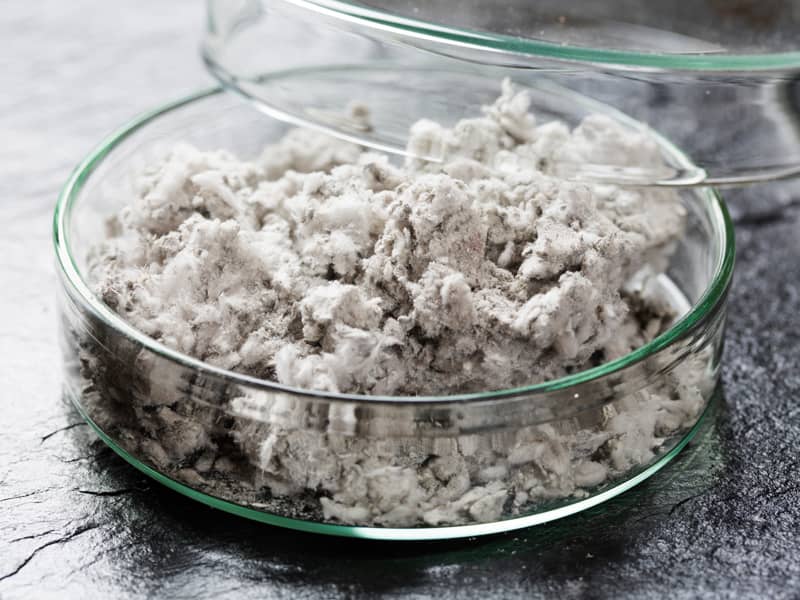
In 2023, a ghost from the past knocked on the doors of more than two thousand British families. Men and women who had crossed paths with it decades earlier, without ever realising what stood in front of them.
They first met it at work.
On construction sites. In shipyards. Inside factories where dust filled the air and settled on every surface. It sat in the materials they handled each day. It clung to roofs, pipes, and insulation. It moved through the air they breathed.
Silent. Invisible. Unnoticed.
It followed them home on their clothes, in their hair, and on their skin. It became part of their routine without ever being named.
This ghost has nothing supernatural about it. It is called asbestos.
And it continues to haunt the United Kingdom.
The curse it leaves behind has a name: mesothelioma. An aggressive disease that can remain hidden for decades before it surfaces. In 2023 alone, it claimed 2,218 lives, according to the latest Health and Safety Executive (HSE) annual report.
What Is Mesothelioma?
Mesothelioma is a form of cancer that, in most cases, affects the pleura, the lining that surrounds the lungs. It is almost always caused by the inhalation of asbestos fibres, and it is almost always fatal.
Most people are diagnosed at an advanced stage because the manifestations are non-specific and appear late in the development of the disease. Once symptoms emerge, survival is typically measured in months rather than years.
What makes mesothelioma particularly cruel is the distance between cause and consequence. The disease has a latency period of at least 30 years, meaning that someone exposed to asbestos in the 1960s or 1970s may only be receiving their diagnosis today. The ghost, in other words, takes its time.
The Latest Figures: Still Thousands of Deaths Every Year
The mesothelioma deaths recorded in Great Britain in 2023 represent a fall from 2,280 in 2022, and are substantially below the average of around 2,500 fatalities per year seen throughout the 2010s. But the scale remains vast.
Each one of those numbers is a person. A family. A working life spent in an industry that exposed them to a substance that would, decades later, prove fatal.
The data does confirm something important: we are past the peak. Annual deaths broadly plateaued throughout the 2010s at around 2,500 per year before beginning to fall from 2021 onwards, consistent with earlier projections that numbers would gradually decline during the 2020s.
The reason for the peak and subsequent fall is that same 30-year latency. The asbestos industry was at its height between roughly 1950 and 1980. Workers exposed during that era are now aged in their 70s, 80s, and beyond, and it is in this age group that the disease is now concentrated. Over 70% of annual mesothelioma deaths in both men and women now occur in those aged over 75.
For men, the decline is already underway. The sharpest early reductions are linked to the elimination of particularly heavy exposures in industries such as shipbuilding, which predominantly affected men.
For women, the picture is different. Female deaths are expected to remain at between 400 and 500 per year throughout the 2020s before beginning to fall, reflecting the later and more diffuse nature of female exposure.
The word “decline,” however, should not be mistaken for “disappearing.” The HSE’s own research confirms that deaths will continue in significant numbers throughout this decade and into the next. The ghost has not yet finished its visits.
Who Is Most at Risk?
The data points clearly to one group: the building trades.
According to the Health and Safety Executive, around 46% of mesothelioma cases among men born in the 1940s link directly to construction-related exposure. Carpenters alone account for 17% of cases in that generation. Much of this risk came from routine contact with brown asbestos insulation board, widely used for fire protection and handled daily without proper safeguards.
Today, the same pattern appears in death records. The occupations most frequently listed include carpenters, joiners, plumbers, electricians, and metal plate workers tied to shipbuilding. These roles formed the core of Britain’s post-war construction boom, responsible for building homes, schools, and hospitals across the country.
For women, it is different. Research suggests that roughly one-third of cases relate to direct exposure, often through living with someone who worked with asbestos.
The remaining cases reflect environmental exposure, linked to time spent in buildings during the peak years of asbestos use.
One figure from the Health and Safety Executive stands out.
In 2024, 1,680 people were assessed for Industrial Injuries Disablement Benefit due to mesothelioma, up from 1,605 in 2023. The trend continues in one direction.
New diagnoses keep coming. In 2025, individuals across the UK still hear the same words for the first time. Many of them remain unaware that the law may entitle them to compensation.
The Legal Position
A mesothelioma diagnosis usually traces back to one cause: asbestos exposure, most often in the workplace. The legal framework reflects that reality.
Mesothelioma compensation claims can move forward even where the employer responsible no longer operates. Often, employers’ liability insurance policies from the time still provide a route to recovery. Where no employer can be identified, statutory compensation schemes offer an alternative path.
If you or a family member has received a mesothelioma diagnosis, it is important to seek legal advice as early as possible.
How Hutcheon Law Can Help
Mesothelioma carries a long history. The link between asbestos and disease now stands well established, and the consequences continue to appear in new diagnoses each year.
Understanding where exposure occurred, who holds responsibility, and what support is available can shape the months ahead in a meaningful way. Acting early makes a difference. It allows evidence to be secured, options to be explored in full, and decisions to be made with confidence at a time when certainty matters most.
Hutcheon Law specialises in asbestos-related claims and offers a no win, no fee service. This approach gives families the confidence to move forward with a claim, knowing that legal fees only apply when compensation is secured.
If you or someone close to you has received a mesothelioma diagnosis, a conversation with Hutcheon Law can provide immediate clarity on your position and the steps ahead.
Start your claim today. Speak to Hutcheon Law for a free, no-obligation assessment and find out if you are eligible for compensation.