A major pooled analysis published in the British Journal of Cancer has provided the most comprehensive assessment to date of how vegetarian and non meat diets influence cancer risk. The study analysed data from 1.8 million participants and examined associations across 17 different cancer types.
The original peer reviewed research can be accessed here:Vegetarian diets and cancer risk: pooled analysis of 1.8 million people – British Journal of Cancer
Vegetarian and non-meat diets and risk of 17 cancers:
This large scale statistical review offers important insight into how dietary patterns may alter the likelihood of developing certain cancers.
Researchers pooled long term cohort data primarily from the United Kingdom and United States. Participants were categorised into dietary groups:
- Meat eaters
- Poultry only eaters
- Vegetarians
- Vegans
The majority of participants, approximately 1.64 million, were meat eaters, consuming on average around 50 grams of meat per day. Statistical models adjusted for smoking, alcohol intake, and body mass index to reduce confounding factors.
The strength of the study lies in its scale, duration of follow up, and its ability to compare multiple cancer types within the same analytical framework.
Five Cancers With Lower Risk in Vegetarians
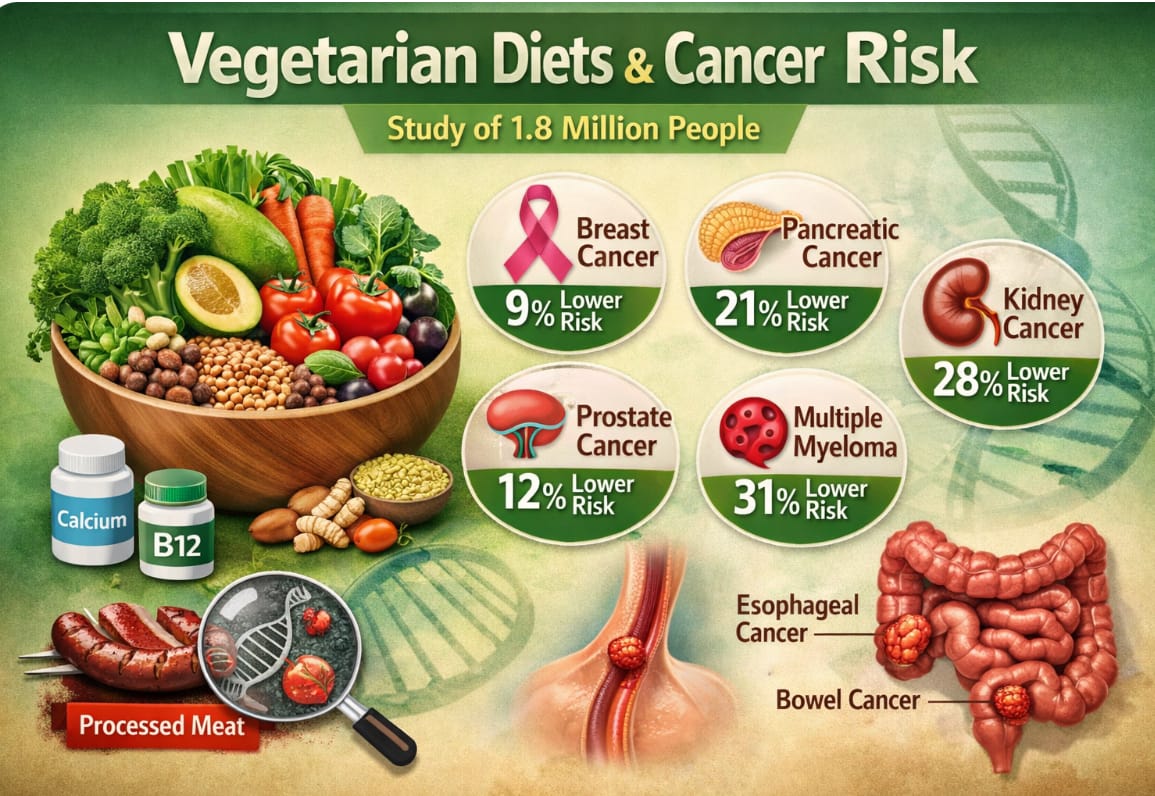
Compared with meat eaters, vegetarians showed statistically significant lower risks of five cancers:
- Pancreatic cancer: 21 percent lower risk
- Breast cancer: 9 percent lower risk
- Prostate cancer: 12 percent lower risk
- Kidney cancer: 28 percent lower risk
- Multiple myeloma: 31 percent lower risk
These are relative risk reductions. To illustrate the public health relevance, if 100,000 comparable meat eaters were expected to develop pancreatic cancer over time, a 21 percent reduction would equate to 79,000 cases in a similar vegetarian population.
A 31 percent lower risk of multiple myeloma represents nearly one third fewer cases relative to meat eaters.
Given that these cancers collectively account for tens of thousands of diagnoses annually in the United Kingdom, even modest percentage reductions may translate into significant population level impact.
Important Statistical Details
The study did not demonstrate universal protection for all cancer types.
Two notable findings require careful interpretation:
- Vegetarians had a higher risk of oesophageal squamous cell carcinoma compared with meat eaters.
- Vegans had a higher risk of colorectal cancer compared with meat eaters.
Researchers suggested that lower intakes of nutrients such as calcium and vitamin B12 may partially explain these associations. Calcium intake in particular has previously been linked with lower bowel cancer risk.
These findings highlight that dietary exclusion without careful nutritional planning may carry unintended consequences.
What about Poultry Only Diets
Participants who consumed poultry but avoided red meat showed slightly lower overall cancer risk compared with those consuming all types of meat. This supports growing evidence that red and processed meat may carry greater carcinogenic potential than white meat.
Possible Mechanisms
Several biological mechanisms may explain the observed associations:
- Processed meats often contain nitrates and nitrites that may form carcinogenic compounds.
- High temperature cooking of red meat can produce DNA damaging chemicals.
- Plant based diets tend to provide higher fibre intake, which may influence gut microbiome composition and reduce inflammation.
The authors suggested that the differences are unlikely to be explained solely by vegetarians being generally healthier, and may reflect direct effects of meat consumption itself.
Public Health Context – Wider Scale
Cancer remains one of the leading causes of death worldwide. Identifying modifiable risk factors such as diet is therefore of substantial importance.
The data suggest that dietary patterns emphasising:
- Wholegrains
- Pulses
- Fruit
- Vegetables
- High fibre foods
- Minimal processed meat
are associated with lower risks of several major cancers.
However, the increased risks observed in certain subgroups reinforce that cancer prevention is complex and multifactorial. Nutritional adequacy remains central.
Balanced Interpretation of the Data
This is the first study to quantify cancer risk differences across 17 tumour types using pooled data from 1.8 million individuals. Its conclusions are statistically robust but should not be interpreted as absolute protection.
Vegetarian diets appear associated with meaningful reductions in pancreatic, breast, prostate, kidney cancers and multiple myeloma. At the same time, careful nutritional planning is essential, particularly for those excluding all animal products.
Diet alone does not determine cancer risk, but the evidence increasingly supports reducing processed and red meat intake as part of a broader cancer prevention strategy.

About Us: Supporting Clients in Delayed Cancer Diagnosis Claims
While prevention and lifestyle factors are important, cancer outcomes are also heavily influenced by timely diagnosis and treatment.
Early detection can significantly improve survival rates across many of the cancers referenced in this study, including pancreatic, breast, prostate and bowel cancer. When diagnosis is delayed, the consequences can be life changing. Tumours may progress to more advanced stages, treatment options may become more limited, and survival prospects can worsen.
As specialist solicitors, we act for individuals and families affected by delayed cancer diagnosis and misdiagnosis. Where there has been:
- A failure to investigate symptoms appropriately
- A delay in referral to a specialist
- Misinterpretation of scan or biopsy results
- Failure to act on abnormal findings
- A delay that has led to disease progression or reduced treatment options
we investigate whether there has been clinical negligence.


Cancer claims are medically complex. They require detailed analysis of medical records, expert oncology evidence and careful assessment of whether earlier diagnosis would have altered staging, treatment or outcome.
We understand that behind every case is a person facing uncertainty, distress and often significant physical and psychological impact. Our role is to provide clear advice, honest assessment and robust representation.
If you or a loved one has experienced a worsening cancer prognosis because of a delayed diagnosis, you may be entitled to pursue a claim.
You can learn more about your legal options on our dedicated page for delayed cancer diagnosis claims
Early advice is important. Time limits apply, and gathering evidence promptly can make a significant difference.
If you would like to discuss your situation in confidence, we are here to help.